Original plan
Require Web3 interest
Recruit loyalty-program users who already expressed interest in the technology.
Youtility · Exploratory UX research
A loyalty-product idea depended on people adopting unfamiliar technology. Working with three other researchers, I helped narrow the brief, bring hesitant shoppers into the study, and connect their concerns to product recommendations.
The product question
Youtility was developing a cross-store loyalty platform with cash and cryptocurrency rewards. The team needed to understand both shoppers’ motivations and the barriers to trying its proposed experience.
Risk and a steep learning curve made shoppers hesitate.
Interest alone would not explain the barriers to adoption.
Investigate knowledge gaps before designing educational onboarding.
Turn a broad adoption question into specific topics for the next research phase.
Portfolio summary of the original research. Recommendations were not tested interface changes or a verified launch.
Read the supporting report excerpt ↓The brief
The initial request covered audience understanding, shopping journeys, design opportunities, Web3 adoption, and competitors. With a fixed three-month timeline, we could not investigate all of those questions in equal depth.
We discussed the product stage and earlier idea-validation work with stakeholders. Together, we prioritized understanding potential users and informing two near-term plans: introducing cryptocurrency rewards and developing a Discord shopping community.
Why do shoppers use loyalty rewards? When do rewards influence a shopping journey, and where do programs become frustrating?
How do shoppers feel about Web3 rewards and a Discord community? What would make either direction difficult to adopt?
That scope gave the study a practical job: clarify the assumptions behind the next product decisions before looking for detailed interface solutions.
Research decision
The original screener required interest in Web3. Many respondents met the other criteria but failed that one. Keeping the filter would have given us a narrower view of adoption—one that omitted people with reasons to hesitate.
Original plan
Recruit loyalty-program users who already expressed interest in the technology.
Adjusted plan
Admit otherwise qualifying shoppers without Web3 interest, and ask why they were not interested.
We also narrowed the loyalty-program questions. Only two of the seven qualifying participants used cash-back, while five used rewards programs exclusively. Rather than force a thin comparison between the two, we focused on rewards.
The study could explore barriers among shoppers who were not already interested in Web3. It could not describe only Web3 enthusiasts, or support a robust cash-back-versus-rewards comparison. Six of the seven interviewees were Millennials, which also limited what we could say about Gen Z.
Findings → recommendations
The useful output was a chain from what we heard to what the team should investigate or prioritize next. Two findings shaped our recommendations.
01 · Cryptocurrency rewards
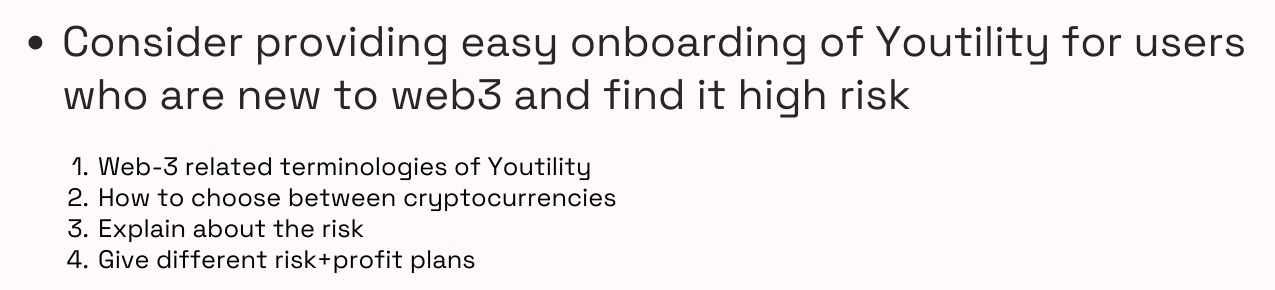
02 · Shopping community
Unfamiliarity was a reason to investigate the community direction, not proof that nobody would use it. Our sample included too few Discord users to answer that second question well.
Synthesis
We developed two promising exploratory profiles—Bargain Hunter and Value Shopper—and compared their loyalty-program journeys. The comparison showed differences in when rewards entered a shopping journey and how they related to the purchase outcome.
For the product team, these were starting points for investigating different needs and routines. Seven interviews could reveal useful patterns, but could not establish the size, prevalence, or stability of those groups across the market.
My takeaway: a profile becomes more useful when it tells the team what to investigate next. Its value here was in focusing follow-up questions, not giving the market a definitive set of labels.
Delivery & reflection
Alongside three other researchers, I contributed to planning, interviews, synthesis, deliverables, and presenting recommendations. We delivered findings, profiles, journey comparisons, and a more focused research agenda to stakeholders.

The result was a set of evidence-informed directions for the next stage of product work. The available record does not establish that the company implemented the recommendations or achieved a measured business outcome.
Recruitment is part of the research question. When a screener removes people who experience the barrier a product must address, changing that screener—and being clear about the resulting limits—can make the study more relevant to the decision at hand.